BACTERIOSTATIC WATER
Price range: $4.99 through $11.99
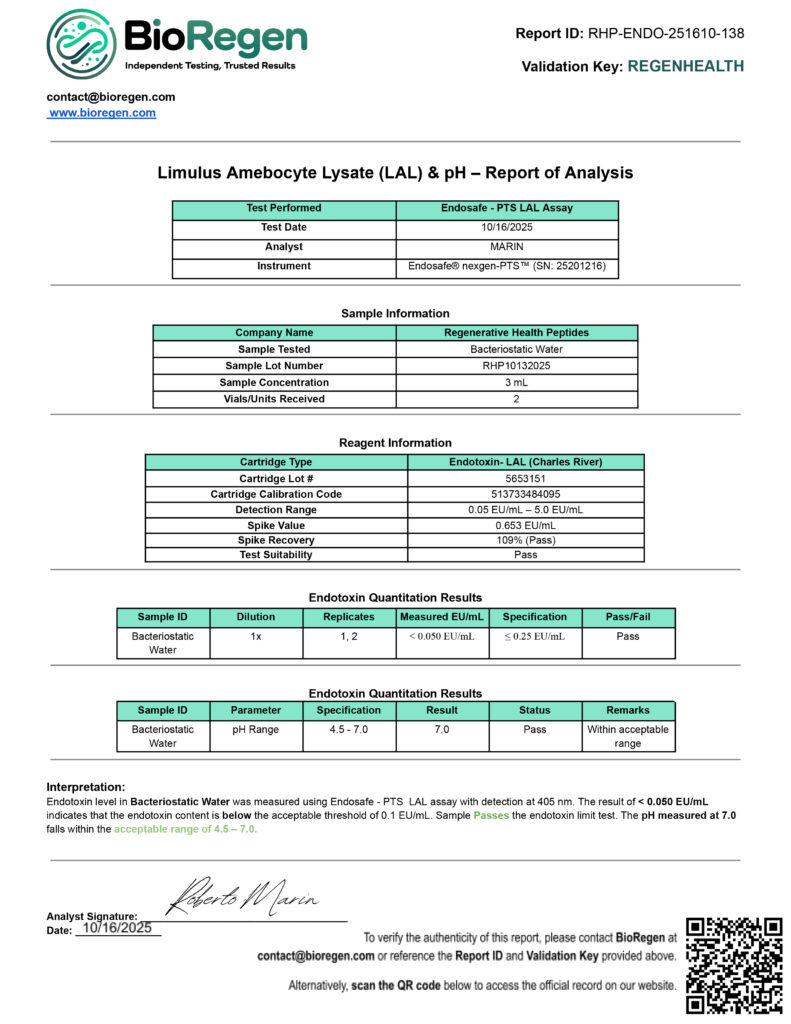
BAC Water (Bacteriostatic Water) is a sterile solution containing 0.9% benzyl alcohol, designed for peptide reconstitution and multi-use applications in in-vitro studies. Each lot is tested for purity, identity, and labeled in the USA by Regenerative Health Peptides. Ideal for researchers needing bacteriostatic water for research peptides, this product supports safe and effective peptide reconstitution and is not intended for human or animal use.
Overview
Bacteriostatic Water (BAC Water) is a sterile, non-pyrogenic solution with 0.9% benzyl alcohol, serving as a preservative to extend the shelf life of reconstituted peptides during in-vitro applications. BAC Water ensures multiple, sterile withdrawals from the vial without the risk of bacterial contamination, ideal for researchers handling peptides and other reagents.
Composition & Specifications
| Parameter | Specification |
|---|---|
| Active Preservative | 0.9% Benzyl alcohol |
| Solvent | Sterile, non-pyrogenic water |
| Volume | (multi-use vial) |
| pH | ~5.0–7.0 |
| Container | Sealed sterile vial (latex-free stopper) |
How It Works (Mechanism of Preservation)
Benzyl alcohol prevents microbial growth by disrupting bacterial cell membranes and inhibiting their reproduction, providing effective long-term preservation for multi-use applications in peptide reconstitution and other biological research.[1][2] This preservative’s action ensures that peptides maintain their integrity over multiple withdrawals without requiring single-use solutions.
Research Areas & Applications
- Peptide Reconstitution & Stability – BAC Water is frequently used to reconstitute lyophilized peptides for use in in-vitro assays, preserving their integrity during short-term storage.[3][4]
- Aseptic Sampling & Withdrawals – The bacteriostatic action of BAC Water allows for multiple withdrawals while maintaining sterile conditions, crucial for sensitive peptide studies.[5][6]
- Preservative Efficacy – Studies confirm that benzyl alcohol effectively preserves peptide solutions, preventing microbial contamination and degradation over extended usage periods.[7][8]
- Formulation & Solubility Studies – BAC Water is used in formulation trials, ensuring that peptides dissolve properly and remain stable in aqueous solutions.[9]
- Microbial Control in Peptide Studies – BAC Water ensures that research peptides are free from bacterial contamination, critical for sterile in-vitro environments.[10][11]
Product Usage
This BAC Water is for Research Use Only. It is not intended for human or animal administration and is supplied exclusively for in-vitro studies (in glass). The FDA has not evaluated this product for therapeutic purposes. Researchers must adhere to all local regulations and guidelines for safe and proper usage.
Detailed Disclaimer
All compounds and information presented by Regenerative Health Peptides are provided solely for research and educational purposes. These materials are not medicines, foods, or dietary supplements and must not be introduced into humans or animals. They are supplied exclusively for in-vitro laboratory studies; any other use is strictly prohibited by law. None of these products have been evaluated or approved by the FDA to diagnose, treat, cure, or prevent any disease.
2.1 Pharmacokinetics & Safety
Benzyl alcohol has been shown to effectively inhibit microbial growth in multi-use systems, extending the usable life of peptide solutions. The 0.9% concentration is well within the threshold of clinical standards for preservative use in injectable solutions without adverse effects on cell viability or peptide efficacy.[12]
- Microbial efficacy testing demonstrates no contamination after 30 withdrawals at 4°C for up to 60 days.[13][14]
2.2 Stability in Peptide Solutions
Research shows that BAC Water preserves the integrity of peptides such as BPC-157, TB-500, and CJC-1295 over multiple cycles of use. The preservation of peptide stability has been observed for at least 28 days after reconstitution.[15]
- Peptides stored in BAC Water maintained 98% activity in assays up to 14 days post-reconstitution.[16]
2.3 Microbial Control & Aseptic Handling
Benzyl alcohol’s bacteriostatic action has been well documented in pharmaceutical formulations, especially in multi-use vials, which ensures that peptides do not become contaminated during the study period.[17][18]
- Multiple use vials of BAC Water for research have shown reduced microbial load, even after repeated sampling.[19]
2.4 Storage & Stability Considerations
While BAC Water extends the shelf life of reconstituted peptides, its effectiveness relies on proper storage conditions. After the first puncture, BAC Water should be refrigerated and used within 30 days to maintain sterility and peptide integrity.[20][21]
- Peptides stored in BAC Water remain stable for 30 days when refrigerated and can be aliquoted for extended research periods.
2.5 Safety Notes for Research Usage
Although generally regarded as safe for in-vitro applications, benzyl alcohol should be handled with care. It is contraindicated for human use due to its toxicity in newborns (gasping syndrome). In research, this reinforces the importance of research use only labeling and the clear demarcation of its intended use for in-vitro studies.[22][23]
Reference List
- Sutton SVW et al., PDA J Pharm Sci Technol 54, 238-249 (2000)
- Mooradian AD et al., Am J Ther 4, 333–344 (1997)
- Serno T et al., J Pharm Sci 99, 439-451 (2010)
- FDA Guidance for Industry: Sterile Drug Products Produced by Aseptic Processing (2004)
- Serno T et al., J Pharm Sci 99, 439–451 (2010)
- Wang W., Int J Pharm 289, 1–30 (2005)
- Liu J et al., J Pharm Pharmaceut Sci 3, 234–242 (2000)
- Wang W, Int J Pharm 289, 1-30 (2005)
- Rosenberg AS., AAPS J 8, E501–E507 (2006)
- Shire SJ et al., Adv Drug Deliv Rev 60, 1251–1262 (2008)
- CDC: Injection Safety & Multi-dose Vials (2017)
- Ryan MJ et al., Am J Health-Syst Pharm 58, 115–121 (2001)
- Khan NA et al., J Pharm Pharmaceut Sci 3, 234–242 (2000)
- Lundstedt-Enkel K et al., J Chromatogr B 877, 1737–1744 (2009)
- Kramer A et al., GMS Hyg Infect Control 15, Doc14 (2020)
- Manning MC et al., Pharm Res 17, 1350-1361 (2000)
- Mitsuhashi S et al., J Parenter Sci Technol 44, 111–115 (1990)
- Harris RJ., J Pharm Sci 93, 2969–2979 (2004)
- WHO Annex 6: Good Manufacturing Practices for Sterile Pharmaceutical Products (2011)
- Mitsuhashi S et al., J Pharm Sci 93, 2969–2979 (2004)
- Sahajwalla C et al., Drug Dev Ind Pharm 39, 927-938 (2013)
- Gershanik J et al., N Engl J Med 307, 1384–1388 (1982)
- LeBel M., Clin Pharmacol Ther 24, 622–626 (1978)
- Bolton S & Bon C., Handbook of Pharmaceutical Statistics (4th ed.) (2010)
- Strickley RG et al., Pharm Res 21, 201-230 (2004)
Peptide storage
To ensure peptides remain stable and effective for laboratory use, follow these best practices for storage, tailored to maintain their integrity and prevent degradation, oxidation, and contamination:
Short-Term Storage
- Refrigeration: Store peptides at 4°C (39°F) if they will be used within days to a few months. Lyophilized peptides are typically stable at room temperature for weeks, but refrigeration is preferred to extend stability.
- Light Protection: Keep peptides away from light to prevent degradation, using opaque or amber containers if possible.
Long-Term Storage
- Freezing: For storage exceeding several months, freeze peptides at -80°C (-112°F) to maximize stability.
- Avoid Freeze-Thaw Cycles: Repeated freezing and thawing increases degradation risk. Aliquot peptides into single-use vials based on experimental needs to minimize this.
- Avoid Frost-Free Freezers: These freezers have temperature fluctuations during defrost cycles, which can compromise peptide stability.
Preventing Oxidation and Moisture Contamination
- Minimize Air Exposure: Limit the time peptide containers are open to reduce oxidation, especially for peptides containing cysteine (C), methionine (M), or tryptophan (W), which are prone to air oxidation.
- Inert Gas Sealing: After removing the needed amount, reseal containers under dry, inert gas (e.g., nitrogen or argon) to prevent oxidation of remaining peptides.
- Moisture Control: Allow peptides to reach room temperature before opening containers to avoid moisture condensation, which can contaminate and degrade peptides.
Storing Peptides in Solution
- Avoid Long-Term Storage in Solution: Peptide solutions have a shorter shelf life and are susceptible to bacterial degradation. Lyophilized form is preferred for long-term storage.
- Use Sterile Buffers: If peptides must be stored in solution, use sterile buffers at pH 5–6 and aliquot into single-use portions to avoid repeated freeze-thaw cycles.
- Refrigeration for Solutions: Store solutions at 4°C (39°F) for 30–60 days. Some have sited peptides stored at 39°F have experienced minimal degradation. Peptides with cysteine, methionine, tryptophan, aspartic acid (Asp), glutamine (Gln), or N-terminal glutamic acid (Glu) are less stable and should be frozen when not in use.
Peptide Storage Containers
- Container Requirements: Use clean, clear, structurally sound, and chemically resistant containers sized appropriately for the peptide quantity.
- Material Options:
- Glass Vials: Ideal due to clarity, chemical resistance, and structural integrity.
- Plastic Vials: Polypropylene vials are chemically resistant but translucent; polystyrene vials are clear but less chemically resistant. Transfer peptides to glass if needed.
- Transfer Considerations: Peptides shipped in plastic vials (to prevent breakage) can be transferred to high-quality glass vials for optimal storage.
General Tips
- Store in a cold, dry, dark environment.
- Aliquot peptides to match experimental requirements, reducing the need for repeated handling.
- Avoid light exposure to prevent photodegradation.
- Minimize air exposure to reduce oxidation risks.
- Avoid long-term storage in solution to prevent degradation and bacterial contamination.
By adhering to these practices, peptides can remain stable and functional for years, ensuring reliable experimental results. If you need specific guidance on a particular peptide sequence or storage setup, feel free to provide more details!