Klotho KP1
5MG
>=99% RP-HPLC Assayed · RUO
$264.95
Klotho KP1 is a 30-amino-acid peptide matching a stretch of the KL1 domain of human…
We supply analytical-grade research compounds for rigorous, data-driven laboratories. Every batch is independently characterized with published lot-specific Certificates of Analysis.
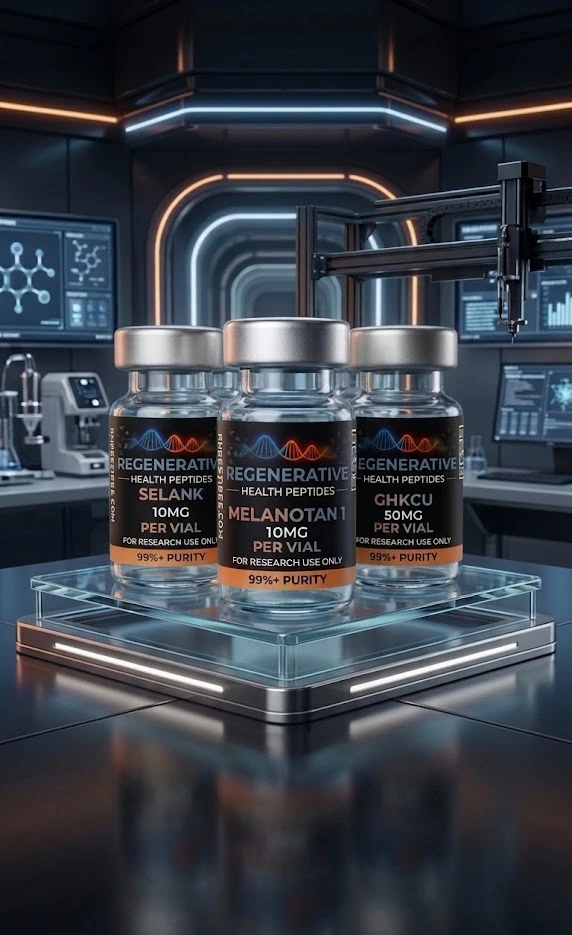
At Regenerative Health Peptides, we supply high-fidelity, analytically characterized compounds to meet the demanding standards of the scientific community. Whether your investigations examine cellular signaling cascades, metabolic regulation, receptor binding kinetics, or structural biology, we offer documented research reagents to support your in-vitro protocols. Every batch is evaluated for chromatographic purity to support consistent, repeatable experimental outcomes.
Research-Grade Reagents: Formulated strictly for in-vitro laboratory experimentation, cellular assays, and biochemical receptor kinetics.
Documented Catalog: Featuring established research peptides such as BPC-157, TB-500, NAD⁺, Semax, and Epithalon, supported by peer-reviewed preclinical literature citations.
Reliable Laboratory Dispatch: Prioritizing secure packaging and prompt courier transit directly to your laboratory facility.
Transparent Data Architecture: Every compound is accompanied by an open-access Certificate of Analysis displaying analytical HPLC chromatographic results.
Independent Laboratory Verification: Compounds undergo analytical evaluation through independent testing laboratories, including Vanguard Laboratory and Janoshik.
Qualified Technical Support: Our dedicated team assists scientific professionals with compound specifications, batch documentation, and order logistics.
Every compound in our catalog is synthesized for rigorous scientific inquiry and independently tested by qualified third-party laboratories. We publish full lot-specific COAs — including analytical RP-HPLC chromatograms and test parameters — so your investigations stand on verifiable data.
Access COA LibraryHigh-Performance Liquid Chromatography (RP-HPLC) separates and quantifies peak area percent to document chromatographic purity. Full chromatogram included in COA.
Exact molecular mass evaluated against theoretical specifications via mass spectrometry for supported analytical compounds.
Every vial carries a unique lot number tied to its published COA, supporting documentation integrity from synthesis to laboratory bench.
Peptides supplied as lyophilized powder in sealed, desiccated glass vials for stability and predictable reconstitution in laboratory solvent.
Our research-grade compounds are characterized to meet exacting laboratory specifications. Every analytical batch is third-party tested by independent analytical laboratories and backed by transparent, lot-specific Certificates of Analysis. Engineered for the strict demands of modern laboratory environments, our catalog enables researchers to conduct precise, repeatable experiments across biochemistry, receptor kinetics, and cellular signaling.
Investigate specific receptor pathways, second messenger cascades, and cellular kinetics with high-fidelity research standards.
Designed with controlled half-lives to facilitate precise temporal modeling and acute exposure studies in vitro.
Leverage superior molecular specificity to minimize off-target effects and yield clearer, more reliable analytical data.
Ideal for preclinical research mapping in-vitro cellular responses to metabolic stress, oxidative pathways, and cytoprotective mechanisms.
Klotho KP1 is a 30-amino-acid peptide matching a stretch of the KL1 domain of human…

Selank is a synthetic 7-amino-acid peptide based on tuftsin, a natural immune-system peptide, with a…

Dihexa is a small synthetic molecule derived from angiotensin IV (N-hexanoyl-Tyr-Ile-aminohexanoic amide). Published studies reported…

KLOW is a four-component research blend of BPC-157 (10 mg), TB-500 (10 mg), KPV (10…

Semax is a synthetic 7-amino-acid peptide built from a fragment of ACTH (ACTH 4-10) joined…

Kisspeptin-10 is the shortest fragment (10 amino acids) of the kisspeptin protein reported to activate…

TB-500 is supplied as thymosin beta-4, a naturally occurring 43-amino-acid protein that binds actin, the…

Sermorelin is a 29-amino-acid fragment (GRF 1-29) of human growth-hormone-releasing hormone. Published work reported that…
Technical documentation for laboratory professionals and principal investigators procuring reagents for in vitro experimentation.
Research Use Only (RUO) designates biochemical reference materials supplied exclusively for in vitro laboratory experimentation, analytical chromatography calibration, and cellular signaling studies by qualified professionals aged 21 and older. Regenerative Health Peptides is a dedicated chemical supplier, not a 503A or 503B compounding pharmacy; all compounds are strictly prohibited from human or veterinary use.
Every production lot undergoes dual-stage analytical characterization via Reverse-Phase High-Performance Liquid Chromatography (RP-HPLC) using C18 stationary columns and UV detection at 214 nm to confirm >=99.0% peak area purity. Identity verification is conducted concurrently via Electrospray Ionization Mass Spectrometry (ESI-MS) to validate observed molecular mass (Da) against theoretical monoisotopic calculations.
Lot-specific Certificates of Analysis (COAs) containing full RP-HPLC chromatographic traces, peak integration tables, retention times, and ESI-MS mass spectra are published directly on each compound product page and indexed in the public COA Library at rhpeptides.com/coa-library. Every physical vial displays a traceable lot identifier matching its archived analytical dataset.
All peptide reagents are supplied as unformulated lyophilized powder cakes sealed inside Type I borosilicate glass vials with butyl rubber stoppers and crimped aluminum flip-off seals. Lyophilization removes residual bound water to prevent hydrolytic degradation during ambient domestic courier transit, preserving structural sequence integrity until laboratory freezer storage.
Unreconstituted lyophilized peptide vials should be stored immediately upon receipt at -20°C in a desiccated, light-protected laboratory freezer to maintain long-term structural stability for up to 24 months. Following solubilization in sterile aqueous laboratory solvent for in vitro cellular assays, working aliquots should be refrigerated at 2°C to 8°C.
Pay with Crypto for fast, secure, and convenient transactions—bringing you trusted peptides with modern, flexible payment options worldwide.
3for2