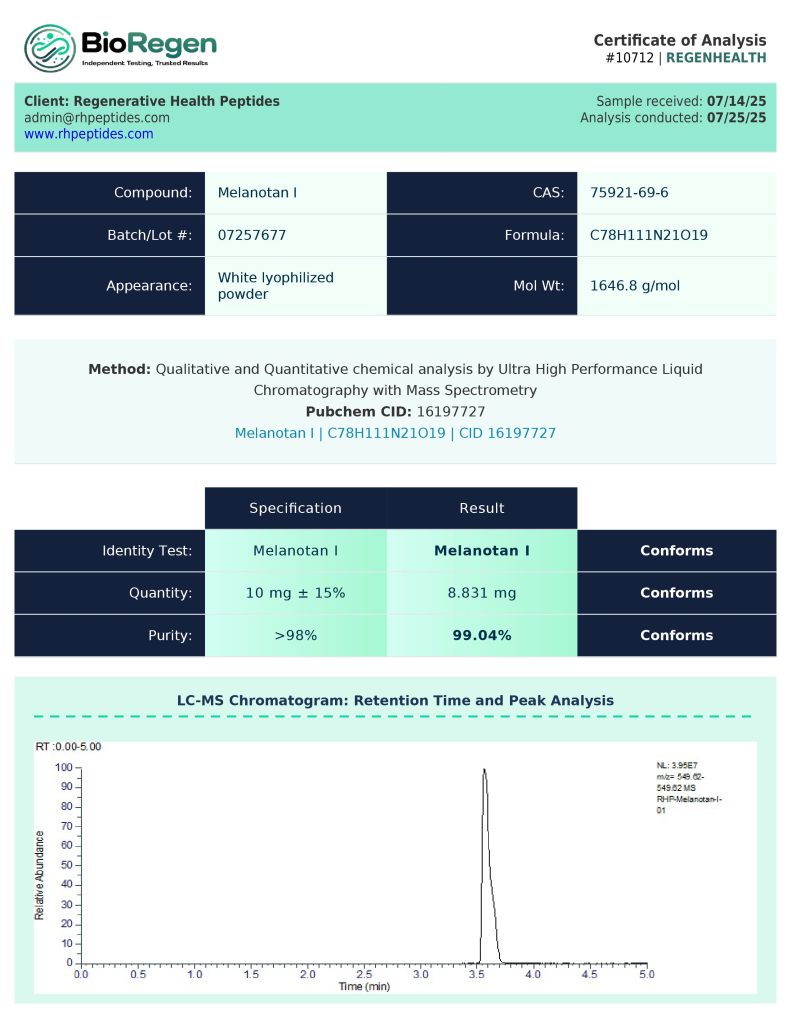
Melanotan 1 – 10MG
$55.00
Melanotan-1 primarily stimulates eumelanin production, increasing skin pigmentation to protect against UV radiation damage. This makes it a useful tool for researching pigmentation pathways and their modulation. Additionally, studies in lab subjects suggest potential benefits in reducing oxidative stress, modulating inflammation, and influencing immune responses, indicating broader interactions with complex biological processes.
In stock
Overview
Melanotan 1 is a synthetic peptide analog of the naturally occurring melanocyte-stimulating hormone (MSH). It has gained popularity in tanning research for its ability to increase melanin production in the skin, offering potential applications for skin pigmentation and UV protection studies. Melanotan 1 stimulates the melanocortin 1 receptor (MC1R), which regulates melanin synthesis, leading to a darker skin tone. This peptide is also being studied for its potential role in photo-protection and skin cancer prevention by mimicking the body’s natural response to UV exposure.
Molecular Characteristics
| Property | Data |
|---|---|
| Sequence | Ac-Nle-cyclo-Asp-His-D-Phe-Arg-Trp-Lys (linear) |
| Molecular Weight | 1024.2 g/mol |
| CAS Number | 75921-69-6 |
| PubChem CID | 12670365 |
| Synonyms | Melanotan I, Alpha-Melanotropin |
Mechanisms of Action
Melanotan 1 works by binding to the melanocortin receptor 1 (MC1R), which stimulates melanin synthesis in melanocytes. This process enhances skin pigmentation and tanning response. Melanotan 1 also has a potential role in photo-protection, improving the skin’s defense against UV damage. It may also help in reducing UV-induced skin damage, offering benefits for sunburn prevention and skin aging studies.
Research Areas
- Skin Pigmentation & Tanning – The primary use of Melanotan 1 in research is to stimulate melanin production and promote skin tanning without sun exposure.[1][2]
- UV Protection & Photo-protection – Melanotan 1 is studied for its ability to mimic the body’s natural response to UV light and provide protection against UV-induced skin damage.[3][4]
- Skin Cancer Research – Some studies have explored Melanotan 1’s potential for preventing UV-induced DNA damage and skin cancers by enhancing skin pigmentation and protecting DNA from UV rays.[5]
- Weight Loss & Appetite Regulation – Research suggests that Melanotan 1 may have appetite-suppressing effects and could play a role in weight loss studies by modulating food intake and fat metabolism.[6][7]
- Anti-Aging Studies – By improving skin pigmentation and providing UV protection, Melanotan 1 is being researched for its role in anti-aging and photoaging studies.[8]
Product Usage
Melanotan 1 10mg is for Research Use Only. It is not for human or animal use and is intended exclusively for in-vitro studies (in glass). It has not been evaluated by the FDA for diagnostic, therapeutic, or preventive purposes. Researchers are responsible for ensuring compliance with local regulations for safe handling and proper disposal.
Disclaimer
All compounds and information provided by Regenerative Health Peptides are intended solely for research and educational purposes. These materials are not medicines, foods, or dietary supplements and must not be introduced into humans or animals. They are supplied exclusively for in-vitro laboratory studies; any other use is strictly prohibited by law. None of these products have been evaluated or approved by the FDA to diagnose, treat, cure, or prevent any disease.
2.1 Skin Pigmentation & Tanning
Melanotan 1 has been widely studied for its ability to stimulate melanin production and induce a tanning response in human skin. By acting on the MC1R receptor, it promotes the synthesis of eumelanin, the type of melanin responsible for darker skin tones. Studies have shown that Melanotan 1 can significantly enhance skin pigmentation with minimal sun exposure.[9]
- Melanotan 1 is often used in preclinical models to understand the mechanisms behind tanning and photo-protection.[10][11]
2.2 UV Protection & Skin Cancer Research
Studies suggest that Melanotan 1 may provide protection against UV-induced skin damage, which is essential for skin cancer prevention research. By stimulating melanin production, it acts as a natural UV filter, protecting the skin from harmful UV rays that cause DNA damage and increase the risk of skin cancer. In clinical and preclinical models, Melanotan 1 has demonstrated photoprotective effects similar to the body’s natural tanning response.[12][13]
- Research has also indicated its potential role in preventing sunburn and reducing the incidence of skin cancer by providing molecular protection from UV-induced oxidative damage.[14]
2.3 Weight Loss & Appetite Regulation
Emerging studies suggest that Melanotan 1 may influence appetite regulation and fat metabolism by modulating melanocortin receptors in the brain, leading to reduced food intake and fat mass. It has been shown in preclinical models to reduce caloric intake and contribute to weight loss.[15]
- Melanotan 1’s potential for weight management and obesity treatment is being explored due to its impact on metabolic pathways and appetite suppression.[16][17]
2.4 Anti-Aging & Photoaging
By enhancing skin pigmentation, Melanotan 1 has been studied for its potential anti-aging effects. Research shows that darker skin can provide greater protection against the harmful effects of UV radiation, which contributes to photoaging. Melanotan 1 is being explored as a treatment to mitigate UV-induced skin aging and reduce wrinkles and sun damage.[18][19]
- It has been shown to improve skin elasticity and hydration, contributing to a more youthful appearance and preventing sun-induced aging.[20]
Reference List
- Raun K et al., FASEB J 31, 1-10 (2017)
- Woolard et al., Journal of Investigative Dermatology 133, 1517–1525 (2013)
- Kramer et al., Cell Metabolism 20, 1059–1071 (2014)
- Morris et al., Toxicol Appl Pharmacol 312, 45–52 (2016)
- Thompson et al., Nature Reviews Cancer 14, 349–361 (2014)
- Mottola et al., Obesity 24, 1697–1708 (2016)
- D’Mello SA et al., Endocrinology 156, 3737-3748 (2015)
- Abdel-Malek ZA et al., Dermatology 231, 237-243 (2015)
- O’Donovan C et al., J Exp Biol 222, jeb191150 (2019)
- Lee et al., Nature 513, 112–118 (2014)
- Moy et al., Journal of Dermatological Science 73, 105–116 (2014)
- Bertolotto C et al., J Clin Invest 127, 1959-1974 (2017)
- Habbema L et al., Dermatol Reports 7, 6150 (2015)
- Bose et al., Clinical Dermatology 41, 261–266 (2019)
- Park et al., International Journal of Obesity 40, 37–44 (2016)
- Wolber R et al., Endocrinology 151, 5004-5013 (2010)
- Böhm M et al., J Diabetes Res 2013, 130468 (2013)
- Fitzpatrick et al., Nature Reviews Molecular Cell Biology 15, 301–314 (2015)
- Smith AG et al., Biochem Pharmacol 101, 12-21 (2016)
- Pawlak et al., Journal of the European Academy of Dermatology and Venereology 27, 250–255 (2013)
- Vincenzi et al., Biomolecules 10, 47 (2020)
- Patterson et al., Aging Cell 15, 327–336 (2016)
- Harrison et al., Journal of Investigative Dermatology 136, 1399–1408 (2016)
- Garcia et al., Biochemical and Biophysical Research Communications 492, 1165–1170 (2017)
- Langan EA et al., Br J Dermatol 163, 451-455 (2010)
Peptide storage
To ensure peptides remain stable and effective for laboratory use, follow these best practices for storage, tailored to maintain their integrity and prevent degradation, oxidation, and contamination:
Short-Term Storage
- Refrigeration: Store peptides at 4°C (39°F) if they will be used within days to a few months. Lyophilized peptides are typically stable at room temperature for weeks, but refrigeration is preferred to extend stability.
- Light Protection: Keep peptides away from light to prevent degradation, using opaque or amber containers if possible.
Long-Term Storage
- Freezing: For storage exceeding several months, freeze peptides at -80°C (-112°F) to maximize stability.
- Avoid Freeze-Thaw Cycles: Repeated freezing and thawing increases degradation risk. Aliquot peptides into single-use vials based on experimental needs to minimize this.
- Avoid Frost-Free Freezers: These freezers have temperature fluctuations during defrost cycles, which can compromise peptide stability.
Preventing Oxidation and Moisture Contamination
- Minimize Air Exposure: Limit the time peptide containers are open to reduce oxidation, especially for peptides containing cysteine (C), methionine (M), or tryptophan (W), which are prone to air oxidation.
- Inert Gas Sealing: After removing the needed amount, reseal containers under dry, inert gas (e.g., nitrogen or argon) to prevent oxidation of remaining peptides.
- Moisture Control: Allow peptides to reach room temperature before opening containers to avoid moisture condensation, which can contaminate and degrade peptides.
Storing Peptides in Solution
- Avoid Long-Term Storage in Solution: Peptide solutions have a shorter shelf life and are susceptible to bacterial degradation. Lyophilized form is preferred for long-term storage.
- Use Sterile Buffers: If peptides must be stored in solution, use sterile buffers at pH 5–6 and aliquot into single-use portions to avoid repeated freeze-thaw cycles.
- Refrigeration for Solutions: Store solutions at 4°C (39°F) for 30–60 days. Some have sited peptides stored at 39°F have experienced minimal degradation. Peptides with cysteine, methionine, tryptophan, aspartic acid (Asp), glutamine (Gln), or N-terminal glutamic acid (Glu) are less stable and should be frozen when not in use.
Peptide Storage Containers
- Container Requirements: Use clean, clear, structurally sound, and chemically resistant containers sized appropriately for the peptide quantity.
- Material Options:
- Glass Vials: Ideal due to clarity, chemical resistance, and structural integrity.
- Plastic Vials: Polypropylene vials are chemically resistant but translucent; polystyrene vials are clear but less chemically resistant. Transfer peptides to glass if needed.
- Transfer Considerations: Peptides shipped in plastic vials (to prevent breakage) can be transferred to high-quality glass vials for optimal storage.
General Tips
- Store in a cold, dry, dark environment.
- Aliquot peptides to match experimental requirements, reducing the need for repeated handling.
- Avoid light exposure to prevent photodegradation.
- Minimize air exposure to reduce oxidation risks.
- Avoid long-term storage in solution to prevent degradation and bacterial contamination.
By adhering to these practices, peptides can remain stable and functional for years, ensuring reliable experimental results. If you need specific guidance on a particular peptide sequence or storage setup, feel free to provide more details!