IGF1-LR3 1MG

$89.99

IGF1-LR3 is a lab-made version of a natural growth factor your body produces called IGF-1 (Insulin-like Growth Factor 1). Scientists designed IGF1-LR3 to be stronger and last longer in the body than regular IGF-1, so it can be more effective in research.
It works by helping cells grow, divide, and repair themselves.
That’s why it’s often studied in areas like: Muscle growth and recovery, Wound Healing, Tissue regeneration, and Nerve protection.
What makes IGF1-LR3 special is that it doesn’t get blocked by the body’s natural “brakes” (called binding proteins), so it stays active longer and reaches more cells.
Researchers use it in lab settings to better understand how growth and repair happen in the body. It’s not for human use, but it’s a powerful tool for studying how cells grow and heal.

In stock

Category:

IGF1-LR3 (Insulin-like Growth Factor-1 Long R3) is a recombinant analog of human IGF-1, engineered for enhanced biological activity and extended half-life. It features a 13-amino acid N-terminal extension and a substitution of arginine at position 3, which reduces binding to IGF-binding proteins and increases potency.

• Sequence: MFPAMPLSSLFDYMRKVIGIGGGC
• Molecular Weight: ~9116 Da
• Form: Lyophilized powder
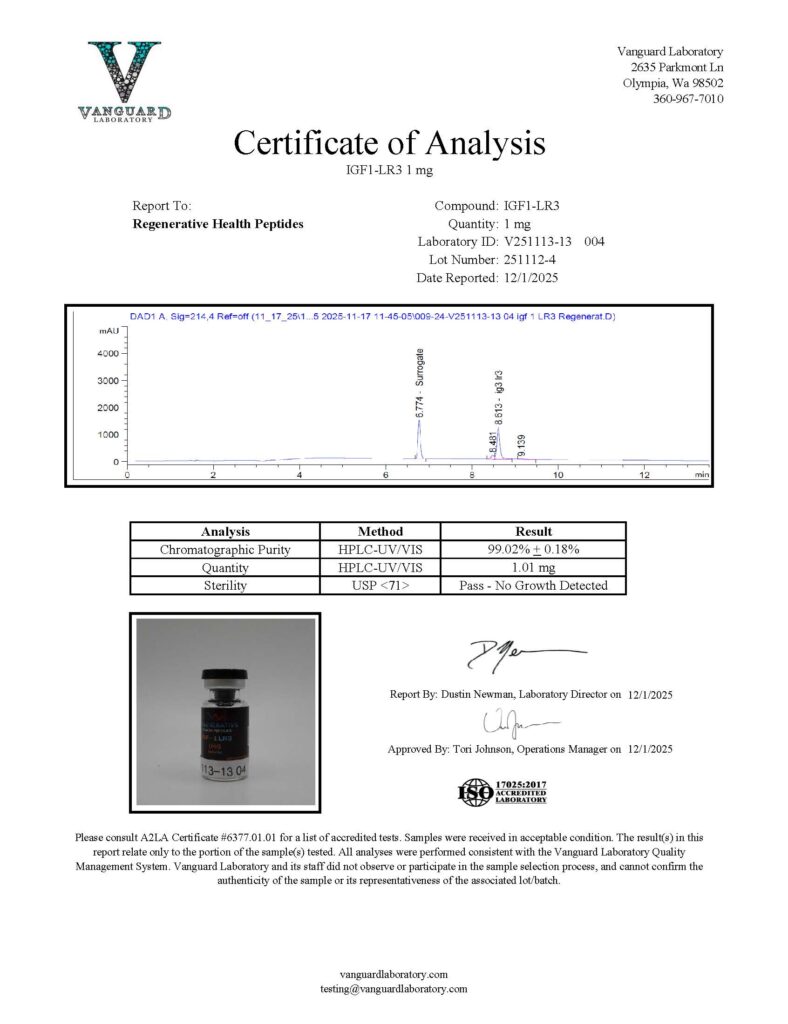
• Purity: ≥99% (HPLC Verified)
• Source: Recombinant expression in E. coli
• Storage: -20°C; protect from light and moisture
• Solubility: Sterile water or 0.6% acetic acid


IGF1-LR3 exerts its effects by binding to the IGF-1 receptor (IGF1R), triggering potent intracellular signaling cascades that regulate growth, repair, and metabolism. Its structural modifications enhance receptor activation and reduce inhibition by binding proteins, making it significantly more bioactive than native IGF-1.


🧬 Mechanism of Action – In Depth

1. Receptor Binding and Activation
IGF1-LR3 binds with high affinity to the IGF-1 receptor (IGF1R), a transmembrane tyrosine kinase receptor expressed in nearly all mammalian tissues. Upon ligand binding:

  • IGF1R undergoes autophosphorylation on intracellular tyrosine residues.
  • This activates downstream signaling pathways critical for cell survival, proliferation, and differentiation.

2. Key Signaling Pathways Activated

🔹 PI3K/Akt Pathway

  • Promotes protein synthesis, glucose uptake, and cell survival.
  • Inhibits pro-apoptotic factors like BAD and caspase-9.
  • Stimulates mTOR, enhancing anabolic processes and muscle hypertrophy.

🔹 MAPK/ERK Pathway

  • Drives cell cycle progression, mitogenesis, and tissue remodeling.
  • Important in neuronal plasticity, wound healing, and angiogenesis.

3. Reduced IGFBP Binding = Greater Bioavailability
Native IGF-1 is tightly regulated by IGF-binding proteins (IGFBPs), which sequester it and limit receptor interaction. IGF1-LR3’s modifications:

  • Arginine substitution at position 3
  • 13-amino acid N-terminal extension

…dramatically reduce its affinity for IGFBPs, especially IGFBP-3 and IGFBP-5. This results in:

  • 3× greater potency than native IGF-1
  • Extended half-life (~20–30 hours vs. ~20 minutes)
  • More sustained receptor activation in research models

4. Cellular Effects in Research Models

  • Muscle tissue: Stimulates satellite cell activation, myoblast proliferation, and myofiber hypertrophy.
  • Adipose tissue: May suppress myostatin and enhance lipolysis.
  • Neural tissue: Supports neurogenesis, synaptic plasticity, and neuroprotection.
  • Connective tissue: Promotes collagen synthesis and fibroblast activity in wound healing.

5. Summary of Functional Outcomes

Effect Pathway Involved Research Implication
Protein synthesis PI3K/Akt → mTOR Muscle growth, recovery
Cell proliferation MAPK/ERK Tissue regeneration, neurogenesis
Anti-apoptosis PI3K/Akt Cell survival under stress
Glucose uptake PI3K/Akt Metabolic regulation
Angiogenesis MAPK/ERK Wound healing, vascular remodeling

IGF1-LR3’s enhanced receptor activation and resistance to IGFBP inhibition make it a powerful tool in models of muscle wasting, tissue repair, and regenerative medicine. Its long-acting profile allows for less frequent dosing and more stable experimental conditions.

Primary Research Areas for IGF1-LR3

1. Muscle Growth and Regeneration

  • IGF1-LR3 promotes satellite cell activation, protein synthesis, and muscle fiber hypertrophy.
  • Commonly used in models of muscle wasting, injury recovery, and anabolic stimulation.

“IGF-1 LR3 enhances muscle hypertrophy and recovery by activating the IGF-1 receptor and downstream anabolic pathways.”

2. Tissue Repair and Wound Healing

  • Supports fibroblast proliferation, collagen synthesis, and angiogenesis.
  • Studied in dermal, tendon, and connective tissue repair models.

“IGF-1 LR3 has shown promise in accelerating tissue regeneration and wound closure in preclinical models.”

3. Neuroprotection and Cognitive Research

  • Investigated for its role in neurogenesis, synaptic plasticity, and protection against neurodegeneration.
  • A 2024 study showed IGF1-LR3 reduced amyloid plaque density in Alzheimer’s mouse models, though cognitive function was not preserved.

“Intranasal IGF-1 LR3 promoted amyloid plaque remodeling in the cerebral cortex of 5XFAD mice.”

4. Metabolic Regulation and Glucose Uptake

  • Enhances glucose transport and insulin sensitivity in muscle and adipose tissue.
  • Explored in models of metabolic syndrome and insulin resistance.

“IGF-1 LR3 stimulates glucose uptake and may improve metabolic substrate availability in skeletal muscle.”

5. Stem Cell and Tissue Engineering

  • Used to promote proliferation and differentiation of mesenchymal stem cells (MSCs) and other progenitor cells.
  • Supports scaffold integration and vascularization in engineered tissues.

“IGF-1 LR3 is increasingly used in tissue engineering for its ability to enhance cell survival and matrix remodeling.”

6. Oncology and Cancer Biology

  • Dual role: may promote tumor growth via mitogenic signaling, but also studied for controlled delivery in regenerative oncology.
  • Requires careful context-specific application due to its proliferative effects.

“Emerging roles of IGF-1 LR3 in oncology highlight both therapeutic potential and risks due to its growth-promoting properties.”

References

Peptide Initiative – How IGF-1 LR3 Works
Peptide Initiative – IGF-1 LR3 Research Database


Storage instructions:

Our products are manufactured using lyophilization, a freeze-drying process that ensures 100% stability for shipping and storage for up to 3-4 months at room temperature. Lyophilization involves freezing the peptides and applying low pressure to sublimate water directly from solid to gas, resulting in a stable, crystalline white powder known as lyophilized peptide.

Once reconstituted with bacteriostatic water, peptides must be refrigerated at under 4°C (39°F) to maintain stability, remaining effective for up to 60 days before noticeable degradation occurs. For immediate use within days, weeks, or a few months, refrigeration is sufficient, as lyophilized peptides are typically stable at room temperature for several weeks.

For long-term storage (several months to years), freezing at temperatures as low as -80°C (-112°F) is recommended to preserve peptide stability. Always store peptides away from light and keep them cold upon receipt to ensure optimal quality.

General Tips

  • Store in a cold, dry, dark environment.
  • Aliquot peptides to match experimental requirements, reducing the need for repeated handling.
  • Avoid light exposure to prevent photodegradation.
  • Minimize air exposure to reduce oxidation risks.
  • Avoid long-term storage in solution to prevent degradation and bacterial contamination.

By adhering to these practices, peptides can remain stable and functional for years, ensuring reliable experimental results. If you need specific guidance on a particular peptide sequence or storage setup, feel free to contact us for more details!