Epithalon:
(also known as Epitalon or Epithalone) is a synthetic tetrapeptide composed of four amino acids: Alanine–Glutamate–Asparagine–Glycine. It was developed in the late 1980s by Russian scientist Vladimir Khavinson as a synthetic analog of epithalamin, a naturally occurring peptide extracted from the pineal gland.
Epithalon has gained attention in aging and cellular biology research due to its ability to stimulate telomerase activity, potentially influencing telomere length and cellular longevity.
Why it’s interesting:
Scientists are fascinated by Epithalon because it seems to “talk” to the machinery that protects your DNA — specifically, the telomeres. Telomeres are like the plastic tips on shoelaces that stop them from fraying. Every time your cells divide, those tips get shorter. When they get too short, the cell can’t divide anymore. Epithalon has been shown in lab studies to help switch on telomerase, the enzyme that can rebuild those tips.
Other effects being studied:
• Sleep & rhythms: It may influence melatonin production, which is tied to sleep cycles and circadian rhythm.
• Cell protection: It’s been linked to reducing oxidative stress — basically helping cells deal with “rust” from free radicals.
• Immune balance: Some studies suggest it can fine‑tune immune responses.
• Cancer research: In certain models, it’s shown anti‑tumor effects, though this is still very early‑stage and not conclusive.
Peptide Structure
Sequence Ala-Glu-Asp-Gly
Molecular formular: C₁₄H₂₂N₄O₉
Molecular Weight: 390.35 g/mol
Classification: Synthetic tetrapeptide
Mechanisms of Action
• Telomerase Modulation
Epithalon has been reported to upregulate telomerase activity in certain cell types, which can influence telomere length maintenance and replicative capacity in model systems.
• Genomic Stability
Linked to reduced rates of chromosomal aberrations and improved DNA repair markers in some experimental settings.
• Pineal Axis and Melatonin Regulation
Associated with modulation of pineal gland function and changes in melatonin synthesis in animal studies, relevant to chronobiology research.
• Antioxidant Effects
Reported to enhance antioxidant defenses and reduce markers of oxidative damage in cells and tissues used in experiments.
• Gene Expression and Signaling Pathways
Influences expression of genes involved in stress response, cell cycle regulation, and apoptosis in context-dependent manners.
• Anti-tumor Effects in Models
Demonstrated inhibitory effects on some tumor models in preclinical research, though mechanisms and reproducibility are active research topics.
Epithalon — Research
Overview
Epithalon (epitalon, epithalone) is a synthetic tetrapeptide (Ala‑Glu‑Asp‑Gly) developed as an analogue of the pineal peptide epithalamin and investigated for effects on telomerase activity, telomere maintenance, pineal function, antioxidant defenses, and aging‑related biomarkers. https://peptideinitiative.com/peptides/epithalon/research .
Key research findings
- Several review and vendor research pages summarize that Epithalon upregulates telomerase activity and can promote telomere elongation in specific experimental cell systems, and that it has been examined for effects on lifespan markers in animal models. https://www.peptides.org/epithalon/ .
- Independent peptide suppliers and research hubs present mechanistic summaries linking Epithalon to modulation of pineal gland function, melatonin synthesis, antioxidant enzyme activity, and genomic stability in preclinical studies. https://peptideinitiative.com/peptides/epithalon/research ; https://uspeptideco.com/wp-content/uploads/2025/05/Epithalon-one-page.pdf .
- Review summaries and educational pages discuss the relationship between telomere biology and Epithalon, providing background on telomeres, telomerase, and why telomere maintenance is a focus in aging research. https://www.peptidesciences.com/peptide-research/telomeres-and-epithalon .
- Popular longevity/education sites compare Epithalon with related peptides (e.g., Thymalin), discussing proposed roles in immune support, regeneration, and chronobiology while citing Russian preclinical literature and translational hypotheses. https://tydes.is/epithalon-thymalin-longevity-immune-research/ .
Mechanisms of action
- Telomerase modulation: reported increases in telomerase activity in some cell models, linked to telomere length effects and replicative capacity changes. https://www.peptides.org/epithalon/ .
- Pineal axis and melatonin: associations with regulation of pineal peptides and melatonin production in animal studies, relevant to circadian biology research. https://peptideinitiative.com/peptides/epithalon/research .
- Antioxidant/repair pathways: reported enhancement of antioxidant enzyme activity and reduced oxidative markers in select preclinical experiments. https://uspeptideco.com/wp-content/uploads/2025/05/Epithalon-one-page.pdf .
- Genomic stability and anti‑tumor observations: some studies report reduced chromosomal aberrations and inhibitory effects on certain tumors in preclinical models; these findings are model‑ and context‑dependent and require further validation. https://www.peptides.org/epithalon/ ; https://www.peptidesciences.com/peptide-research/telomeres-and-epithalon .
Preclinical evidence and research areas
- Cellular senescence and telomere biology: in vitro and animal model studies examining telomerase activity, telomere length, and markers of cellular aging. https://www.peptides.org/epithalon/ ; https://www.peptidesciences.com/peptide-research/telomeres-and-epithalon .
- Chronobiology and pineal research: animal studies assessing pineal gland peptides, melatonin levels, and circadian endpoints. https://peptideinitiative.com/peptides/epithalon/research .
- Oxidative stress and DNA repair: experiments reporting modulation of antioxidant enzymes and reduced oxidative damage markers. https://uspeptideco.com/wp-content/uploads/2025/05/Epithalon-one-page.pdf .
- Oncology models: selective preclinical reports of tumor growth inhibition in specific contexts; interpretation requires caution and replication. https://www.peptides.org/epithalon/ .
Practical notes for researchers
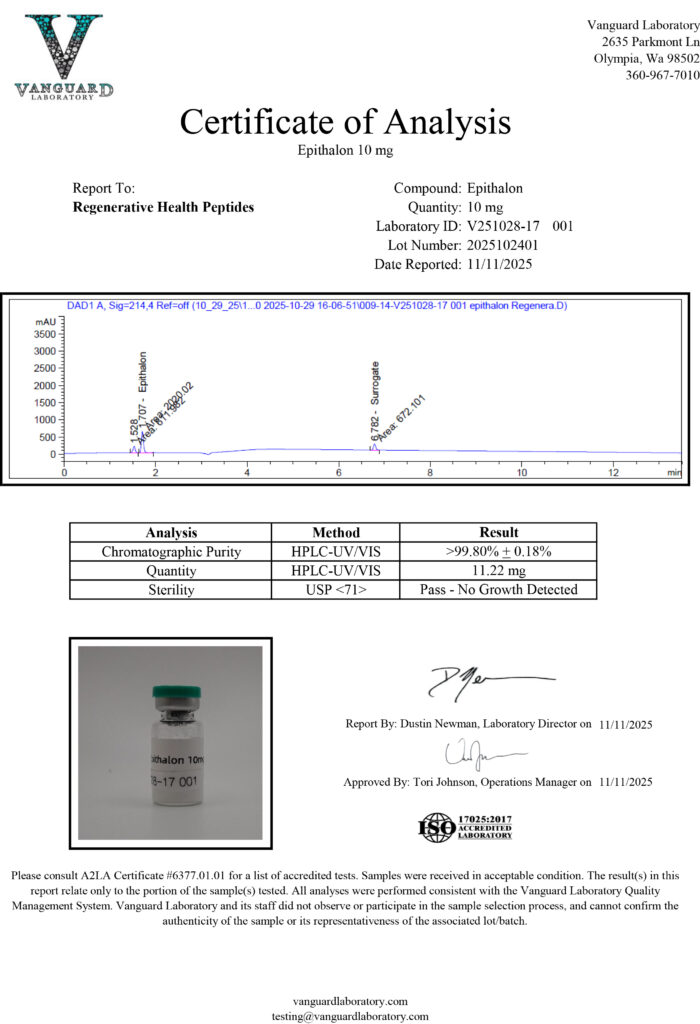
- Many vendor summaries and research hubs emphasize using validated analytical methods (HPLC, MS) to confirm identity and purity prior to experiments and recommend stability controls, appropriate storage, and use of matched experimental controls. https://peptideinitiative.com/peptides/epithalon/research ; https://uspeptideco.com/wp-content/uploads/2025/05/Epithalon-one-page.pdf .
- Interpret preclinical results cautiously; most published evidence is preclinical or from non-randomized/limited studies, and reproducibility, dose‑response, pharmacokinetics, and safety profiles need comprehensive peer‑reviewed data for translational claims. https://www.peptides.org/epithalon/ .
References
- Epithalon Research Hub — Peptide Initiative. https://peptideinitiative.com/peptides/epithalon/research .
- Epithalon and Thymalin: Peptides for Longevity, Immune Support, and Regeneration — Tydes. https://tydes.is/epithalon-thymalin-longevity-immune-research/ .
- Epithalon | Reviews, Clinical Trials, and Safety — Peptides.org. https://www.peptides.org/epithalon/ .
- Epithalon one-page (vendor PDF) — US Peptide Co. https://uspeptideco.com/wp-content/uploads/2025/05/Epithalon-one-page.pdf .
- Telomeres and Epithalon — PeptideSciences. https://www.peptidesciences.com/peptide-research/telomeres-and-epithalon .
Storage instructions:
Our products are manufactured using lyophilization, a freeze-drying process that ensures 100% stability for shipping and storage for up to 3-4 months at room temperature. Lyophilization involves freezing the peptides and applying low pressure to sublimate water directly from solid to gas, resulting in a stable, crystalline white powder known as lyophilized peptide.
Once reconstituted with bacteriostatic water, peptides must be refrigerated at under 4°C (39°F) to maintain stability, remaining effective for up to 60 days before noticeable degradation occurs. For immediate use within days, weeks, or a few months, refrigeration is sufficient, as lyophilized peptides are typically stable at room temperature for several weeks.
For long-term storage (several months to years), freezing at temperatures as low as -80°C (-112°F) is recommended to preserve peptide stability. Always store peptides away from light and keep them cold upon receipt to ensure optimal quality.
General Tips
- Store in a cold, dry, dark environment.
- Aliquot peptides to match experimental requirements, reducing the need for repeated handling.
- Avoid light exposure to prevent photodegradation.
- Minimize air exposure to reduce oxidation risks.
- Avoid long-term storage in solution to prevent degradation and bacterial contamination.
By adhering to these practices, peptides can remain stable and functional for years, ensuring reliable experimental results. If you need specific guidance on a particular peptide sequence or storage setup, feel free to contact us for more details!