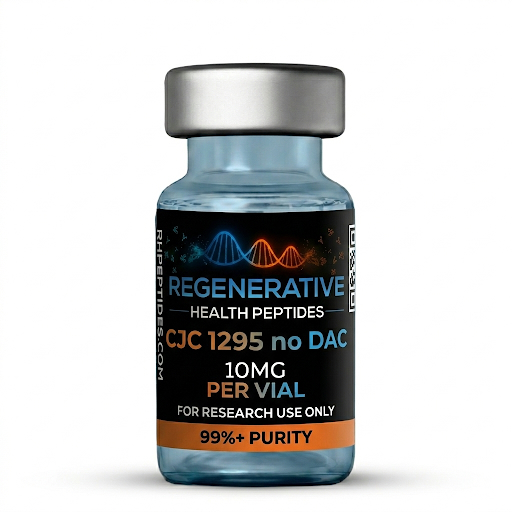
CJC-1295 (No DAC) 10MG
$109.99
CJC-1295 No DAC works by mimicking the action of GHRH. When administered, it binds to GHRH receptors in the pituitary gland, which leads to an increase in the secretion of growth hormone. This increase in growth hormone can result in various physiological benefits, including muscle growth, fat loss, and improved recovery times.
In stock
Overview
CJC-1295 (No DAC) is the tetrasubstituted analog of GHRH (1-29)-NH₂ (often called MOD-GRF (1-29)) engineered to improve stability against DPP-IV cleavage while retaining short, pulse-like pharmacodynamics seen with native GHRH (1-29)/Sermorelin. Unlike the DAC-conjugated version, No-DAC does not bind albumin, keeping the half-life short (minutes) and supporting discrete GH pulses—a feature widely leveraged in endocrine and metabolism research. [3][4][7][8][16]
- Receptor & pathway: Binds the GHRH receptor (GHRH-R) on pituitary somatotrophs, activating Gs → adenylyl cyclase → cAMP → PKA → CREB signaling to trigger GH synthesis and secretion. [12][13][17]
- Pulsatility matters: Research shows pulsatile GH release is preserved (and physiologically desirable) versus sustained elevation; No-DAC analogs are commonly used to model physiologic pulses. [11][16]
- Synergy: Co-stimulation with GHRPs (e.g., ipamorelin) is synergistic, often used to model near-maximal GH secretory capacity without overriding negative feedback. [14][15][24]
Molecular/Design Notes
- Backbone: GHRH(1-29)-NH₂ analog (a.k.a. Sermorelin backbone) with four substitutions to reduce DPP-IV and trypsin-like degradation. [3][5][18]
- No DAC: Lacks the Drug Affinity Complex—no albumin tethering, no multi-day exposure (that profile is specific to DAC-CJC-1295). [1][11]
Typical Research Use Cases (in-vitro)
- Somatotroph signaling & GH pulsatility models
- Endocrine-metabolic crosstalk (GH → IGF-1 axis, lipolysis)
- Comparative studies: No-DAC pulse vs DAC sustained profiles
- Combination paradigms: GHRH analog + GHRP synergy mapping [14][15][24]
SKU note: This product is offered in 5 mg and 10 mg formats to fit protocol design and customizable dosing needs for lab testing (e.g., titration experiments). For research purposes only – CJC-1295 peptide.
Disclaimer (expanded)
All compounds and information provided by Regenerative Health Peptides are intended exclusively for laboratory research and educational purposes. Products are not medications and are not for human or animal use, including but not limited to diagnosis, treatment, cure, or prevention of any disease. Items are tested for purity, ID, and labelled in the USA and supplied for in-vitro studies only. Researchers are responsible for compliance with all applicable regulations.
Background & Rationale
- Long-acting GHRH analog (DAC variant) evidence: Early clinical investigations with DAC-CJC-1295 established durable increases in GH/IGF-1 and showed pulsatility persists despite continuous receptor stimulation—useful contrast for No-DAC pulse models. 1 11 15
- Why No-DAC? DPP-IV rapidly cleaves native GHRH; tetrasubstitution enhances stability but keeps exposure short, enabling discrete pulse studies closer to physiology. 3 5 7 8 18
Key Findings & Methods Supporting No-DAC Use
- Teichman et al.: Long-acting CJC-1295 increases GH/IGF-1 (context for comparative pulse vs. sustained designs).
- Ionescu et al.: Pulsatile GH secretion persists under prolonged GHRH-R stimulation (physiology preserved).
- Frohman et al.: DPP-IV is the primary plasma protease degrading GHRH; rationale for DPP-IV-resistant analogs.
- Mulvihill & Drucker: Comprehensive review of DPP-4 biology impacting peptide hormones (GHRH among substrates).
- Martin et al.: DPP-IV cleavage mapping on GRF analogs; substitution effects.
- Rafferty et al.: GHRH(1-29) analogs: plasma half-life minutes; supports short-acting profile.
- Soule et al.: D-Ala² substitution extends half-life and reduces clearance in men.
- Aitman et al.: Native vs agonist GHRH(1-29)-NH₂—similar peak GH at submaximal dosing.
- Spoudeas et al.: Dose–response to GHRH(1-29)-NH₂ (low-dose testing).
- Cohen et al.: GHRH-R → cAMP/PKA/CREB transcriptional control in somatotrophs.
- Ivanova et al.: cAMP in pituitary—central to GH transcription/release.
- Olarescu & Jørgensen: Normal GH physiology and pulsatility.
- Vijayakumar et al.: GH in metabolism (lipolysis, IGF-1 axis).
- Bowers 1990: GHRH + GHRP → synergy in GH release (independent mechanisms).
- Bowers et al. 2004: Sustained pulsatile GH with GHRH + GHRP-2 combined stimuli.
- Peroni et al.: GHRP-2 actions on somatotrophs; secretagogue physiology.
- Sigalos et al.: Safety/efficacy of GHS; synergy with GHRH highlighted.
- Knoop et al.: Analytical identification of GHRH analogs (incl. CJC-1295) and metabolites.
- Memdouh et al.: Detection of sermorelin, tesamorelin, CJC-1295 variants—analytical context for labs.
- Timms et al.: LC-MS/MS confirmation of CJC-1295 in equine plasma.
- Khorram et al.: Nightly GHRH analog activates somatotropic axis in older adults (physiology reference).
- Khorram et al.: Immune effects of GHRH analogs in aging men.
- Maheshwari et al.: GH pulsatility persists even with altered GHRH-R signaling.
- Paulo et al.: Two-peptide synergy (GHRH + GHRP-2) in secretion testing.
- Halmos et al.: GHRH-R signaling pathways (updated mechanistic review).
Note: Items 1–2 describe DAC-CJC-1295 to contextualize No DAC pulse vs DAC sustained paradigms (useful in comparative lab designs). All citations are peer-reviewed resources relevant to GHRH analog design, signaling, pulsatility, DPP-IV degradation, and analytical detection.
Storage instructions:
Our products are manufactured using lyophilization, a freeze-drying process that ensures 100% stability for shipping and storage for up to 3-4 months at room temperature. Lyophilization involves freezing the peptides and applying low pressure to sublimate water directly from solid to gas, resulting in a stable, crystalline white powder known as lyophilized peptide.
Once reconstituted with bacteriostatic water, peptides must be refrigerated at under 4°C (39°F) to maintain stability, remaining effective for up to 60 days before noticeable degradation occurs. For immediate use within days, weeks, or a few months, refrigeration is sufficient, as lyophilized peptides are typically stable at room temperature for several weeks.
For long-term storage (several months to years), freezing at temperatures as low as -80°C (-112°F) is recommended to preserve peptide stability. Always store peptides away from light and keep them cold upon receipt to ensure optimal quality.
General Tips
- Store in a cold, dry, dark environment.
- Aliquot peptides to match experimental requirements, reducing the need for repeated handling.
- Avoid light exposure to prevent photodegradation.
- Minimize air exposure to reduce oxidation risks.
- Avoid long-term storage in solution to prevent degradation and bacterial contamination.
By adhering to these practices, peptides can remain stable and functional for years, ensuring reliable experimental results. If you need specific guidance on a particular peptide sequence or storage setup, feel free to contact us for more details!

