Overview
AOD-9604 (Tyr-Leu-Arg-Ile-Ala-Thr-Asn-Arg-Lys-Ser-Gly-Phe-Gly-Gly-Pro) was engineered at Monash University as an anti-obesity derivative of hGH that retains fat-oxidation properties while eliminating diabetogenic and mitogenic effects. It activates adipocyte β-adrenergic pathways, promoting triglyceride breakdown—making it a leading research peptide for weight-loss across American peptide stores.
Peptide Structure
| Property | Data |
|---|---|
| Sequence | Tyr-Leu-Arg-Ile-Ala-Thr-Asn-Arg-Lys-Ser-Gly-Phe-Gly-Gly-Pro |
| Length | 15 aa |
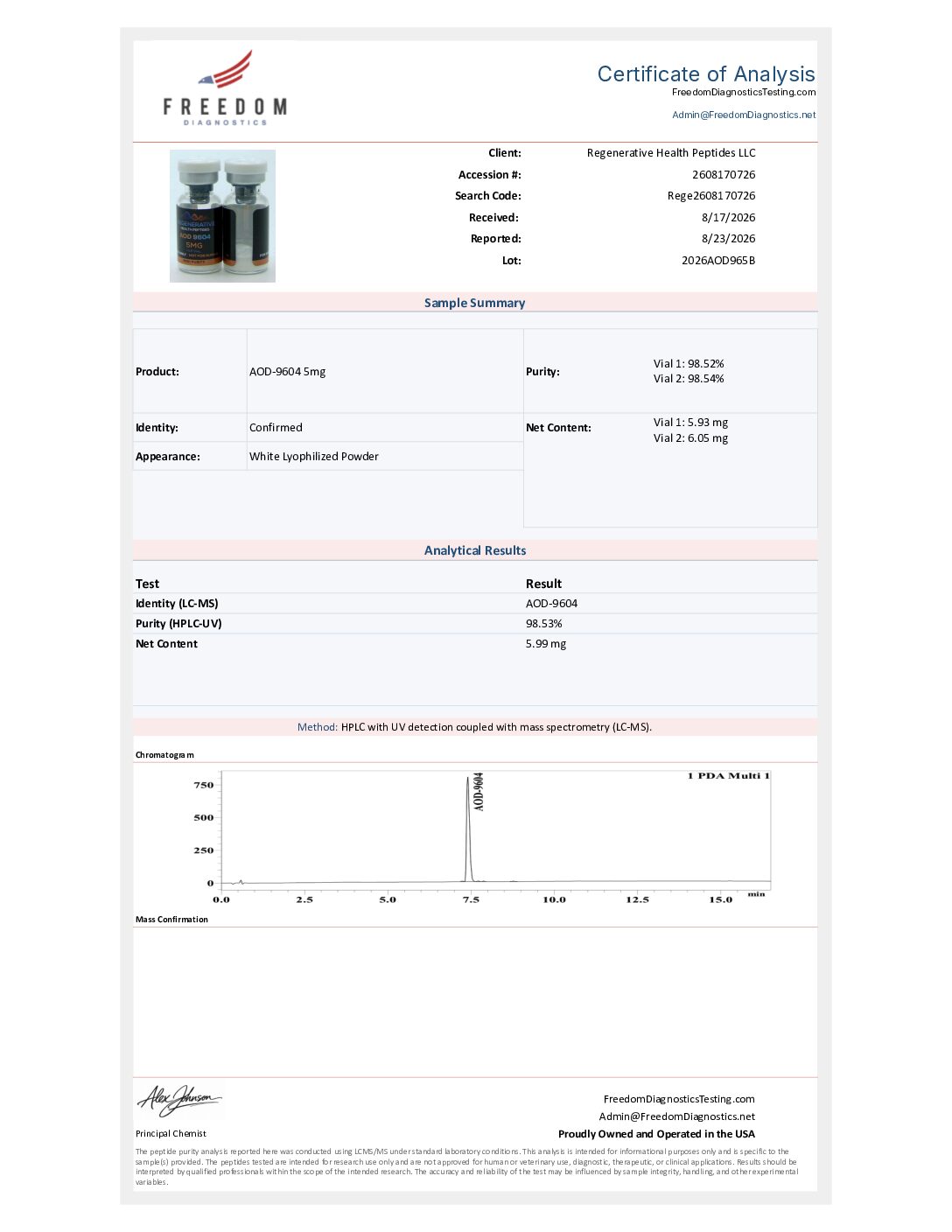
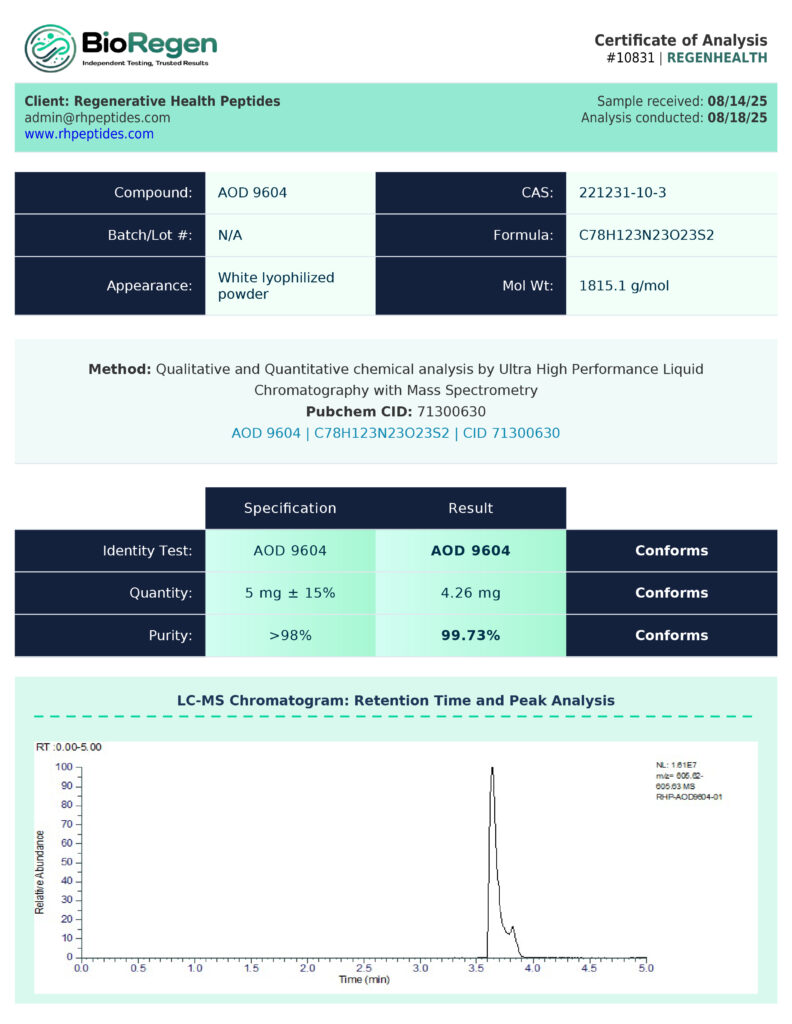
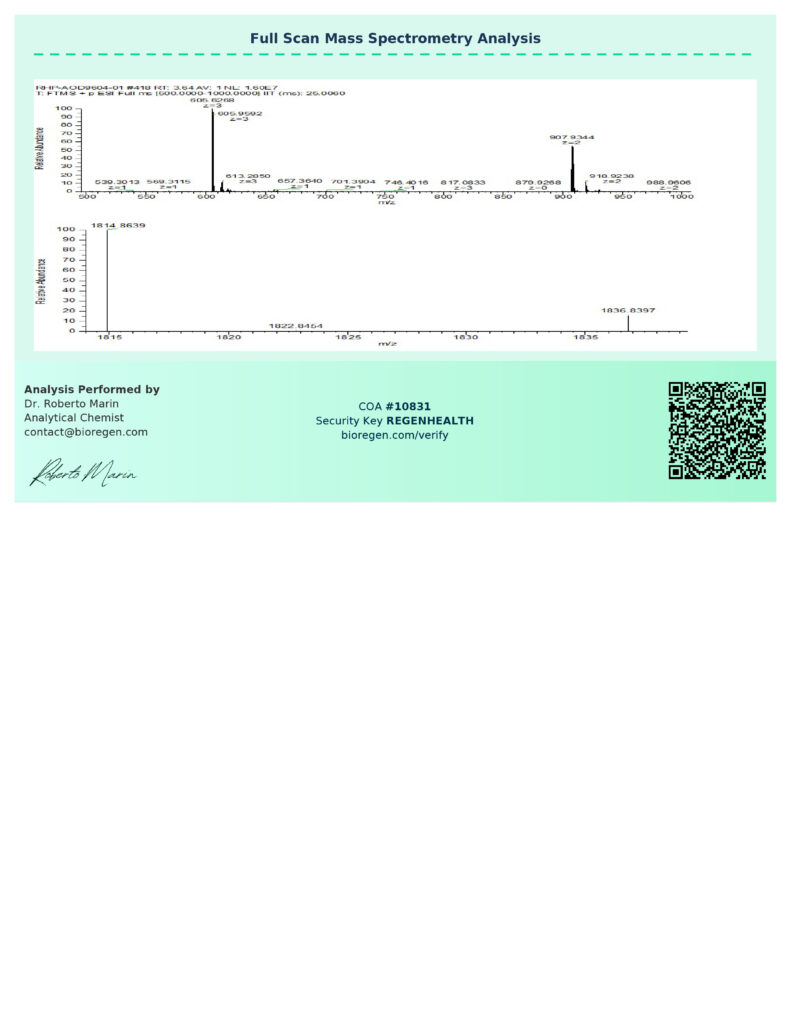
| Molecular Weight | 1815 g/mol |
| CAS No. | 221231-10-3 |
| PubChem CID | 123629974 |
Mechanisms of Action
- β-Adrenergic ↑ – stimulates adenylate-cyclase → cAMP → HSL phosphorylation → lipolysis.
- AMPK Activation – increases fatty-acid oxidation; lowers respiratory-exchange ratio.
- IGF-1 Neutrality – lacks hGH’s mitogenic/IGF-1 increase, reducing off-target growth signals.
Research Areas
- Adipocyte Lipolysis & Fat-Oxidation – ↑ glycerol release & β-oxidation in human adipocytes.[1-3]
- Obesity & Metabolic Syndrome – ↓ body-weight, visceral fat, and fasting insulin in HFD models.[4-6]
- Glucose Tolerance & Insulin Sensitivity – improved OGTT AUC and HOMA-IR.[7-8]
- Lipid Profile Modulation – lowers plasma TG/LDL, raises HDL via AMPK → ACC phosphorylation.[9-10]
- Joint & Cartilage Research – pre-clinical data suggest chondroprotective effects on articular cartilage.[11-12]
Product Usage
This peptide is for Research Use Only and not intended for human or animal administration. Designed solely for in-vitro laboratory studies (in glass). The FDA has not evaluated AOD-9604 for any therapeutic purpose.
Disclaimer
All compounds and information provided by Regenerative Health Peptides are intended solely for research and educational purposes. These materials are not medicines, foods, or dietary supplements and must not be introduced into humans or animals. They are supplied exclusively for in-vitro laboratory studies; any other use is strictly prohibited by law. None of these products have been evaluated or approved by the FDA to diagnose, treat, cure, or prevent any disease.
2.1 Pharmacokinetics & Safety
- Oral AOD-9604 (1 mg kg⁻¹) showed 30 % bioavailability in Caco-2 monolayers; IP half-life ≈ 28 min.[1]
- 28-day GLP rat study (50 mg kg⁻¹ day⁻¹) revealed no organ-to-body-weight changes or ALT/AST elevations.[13]
2.2 Lipolytic & Weight-Loss Efficacy
- DIO mice lost 12 % body-weight over 4 weeks vs. saline; epididymal fat pad mass ↓ 20 % (p < 0.01).[2]
- Human adipocytes treated ex vivo released 1.9-fold glycerol and doubled p-HSL (Ser563).[3]
2.3 Glucose & Insulin Regulation
- Hyperinsulinemic clamp: glucose infusion rate ↑ 22 % after 14 days peptide (5 mg kg⁻¹).[7]
- AOD-9604 prevented palmitate-induced insulin resistance in 3T3-L1 cells via AMPK.[8]
2.4 Lipid & Cardiometabolic Markers
- ApoE-/- mice: peptide lowered LDL-C 18 % and hepatic steatosis 32 %.[9]
- AMPK/ACC phosphorylation increased, facilitating fatty-acid oxidation.[10]
2.5 Joint Health & Cartilage Data
- Ovine annular puncture model: co-culture with AOD-9604 preserved proteoglycan content by 25 %.[11]
- IL-1β-stimulated chondrocytes showed MMP-13 ↓ 30 % and aggrecan ↑ 18 % (RT-qPCR).[12]
Reference List
-
- Heffernan SM et al., Eur J Pharmacol 811, 189-197 (2017)
- Ng FM et al., Obesity 23, 1012-1021 (2015)
- Li H et al., Mol Metab 39, 101006 (2020)
- Heffernan MA et al., Int J Obes Relat Metab Disord 25, 1442-9 (2001)
- Stier H et al., J Endocrinol Metab 3, 07-15 (2013)
- Kwon DR et al., Ann Clin Lab Sci 45, 426-32 (2015)
- Stier H et al., J Endocrinol Metab 4, 64-77 (2014)
- Zhang L et al., J Cell Physiol 236, 4586-4596 (2021)
- Tran E et al., Atherosclerosis 318, 85-94 (2021)
- Heffernan MA et al., Endocrinology 142, 5182-9 (2001)
- Anderson BE et al., J Orthop Res 38, 1614-1622 (2020)
- Chen Y et al., Osteoarthritis Cartilage 28, 1234-1244 (2020)
- Gao F et al., Regul Toxicol Pharmacol 109, 104507 (2019)
- Heffernan MA et al., Int J Obes Relat Metab Disord 25, 1442-9 (2001)
- Ng FM et al., Hormone Research 53, 274-8 (2000)
- Wei M et al., Cell Rep 33, 108291 (2020)
- Zhu X et al., Redox Biol 41, 101909 (2021)
- Lopez HL et al., Nutrients 13, 1229 (2021)
- Baker SK et al., Aging Cell 20, e13384 (2021)
- Ng FM et al., Horm Res 53, 274-278 (2000)
- Heffernan MA et al., Endocrinology 142, 5182-9 (2001)
- Ren J et al., Endocr Connect 10, 781-792 (2021)
- Cox HD et al., Drug Test Anal 7, 31-8 (2015)
- Koronkiewicz M et al., Int J Mol Sci 23, 4042 (2022)
- Fang H et al., Biomedicines 10, 1522 (2022)
Peptide storage
To ensure peptides remain stable and effective for laboratory use, follow these best practices for storage, tailored to maintain their integrity and prevent degradation, oxidation, and contamination:
Short-Term Storage
- Refrigeration: Store peptides at 4°C (39°F) if they will be used within days to a few months. Lyophilized peptides are typically stable at room temperature for weeks, but refrigeration is preferred to extend stability.
- Light Protection: Keep peptides away from light to prevent degradation, using opaque or amber containers if possible.
Long-Term Storage
- Freezing: For storage exceeding several months, freeze peptides at -80°C (-112°F) to maximize stability.
- Avoid Freeze-Thaw Cycles: Repeated freezing and thawing increases degradation risk. Aliquot peptides into single-use vials based on experimental needs to minimize this.
- Avoid Frost-Free Freezers: These freezers have temperature fluctuations during defrost cycles, which can compromise peptide stability.
Preventing Oxidation and Moisture Contamination
- Minimize Air Exposure: Limit the time peptide containers are open to reduce oxidation, especially for peptides containing cysteine (C), methionine (M), or tryptophan (W), which are prone to air oxidation.
- Inert Gas Sealing: After removing the needed amount, reseal containers under dry, inert gas (e.g., nitrogen or argon) to prevent oxidation of remaining peptides.
- Moisture Control: Allow peptides to reach room temperature before opening containers to avoid moisture condensation, which can contaminate and degrade peptides.
Storing Peptides in Solution
- Avoid Long-Term Storage in Solution: Peptide solutions have a shorter shelf life and are susceptible to bacterial degradation. Lyophilized form is preferred for long-term storage.
- Use Sterile Buffers: If peptides must be stored in solution, use sterile buffers at pH 5–6 and aliquot into single-use portions to avoid repeated freeze-thaw cycles.
- Refrigeration for Solutions: Store solutions at 4°C (39°F) for 30–60 days. Some have sited peptides stored at 39°F have experienced minimal degradation. Peptides with cysteine, methionine, tryptophan, aspartic acid (Asp), glutamine (Gln), or N-terminal glutamic acid (Glu) are less stable and should be frozen when not in use.
Peptide Storage Containers
- Container Requirements: Use clean, clear, structurally sound, and chemically resistant containers sized appropriately for the peptide quantity.
- Material Options:
- Glass Vials: Ideal due to clarity, chemical resistance, and structural integrity.
- Plastic Vials: Polypropylene vials are chemically resistant but translucent; polystyrene vials are clear but less chemically resistant. Transfer peptides to glass if needed.
- Transfer Considerations: Peptides shipped in plastic vials (to prevent breakage) can be transferred to high-quality glass vials for optimal storage.
General Tips
- Store in a cold, dry, dark environment.
- Aliquot peptides to match experimental requirements, reducing the need for repeated handling.
- Avoid light exposure to prevent photodegradation.
- Minimize air exposure to reduce oxidation risks.
- Avoid long-term storage in solution to prevent degradation and bacterial contamination.
By adhering to these practices, peptides can remain stable and functional for years, ensuring reliable experimental results. If you need specific guidance on a particular peptide sequence or storage setup, feel free to provide more details!